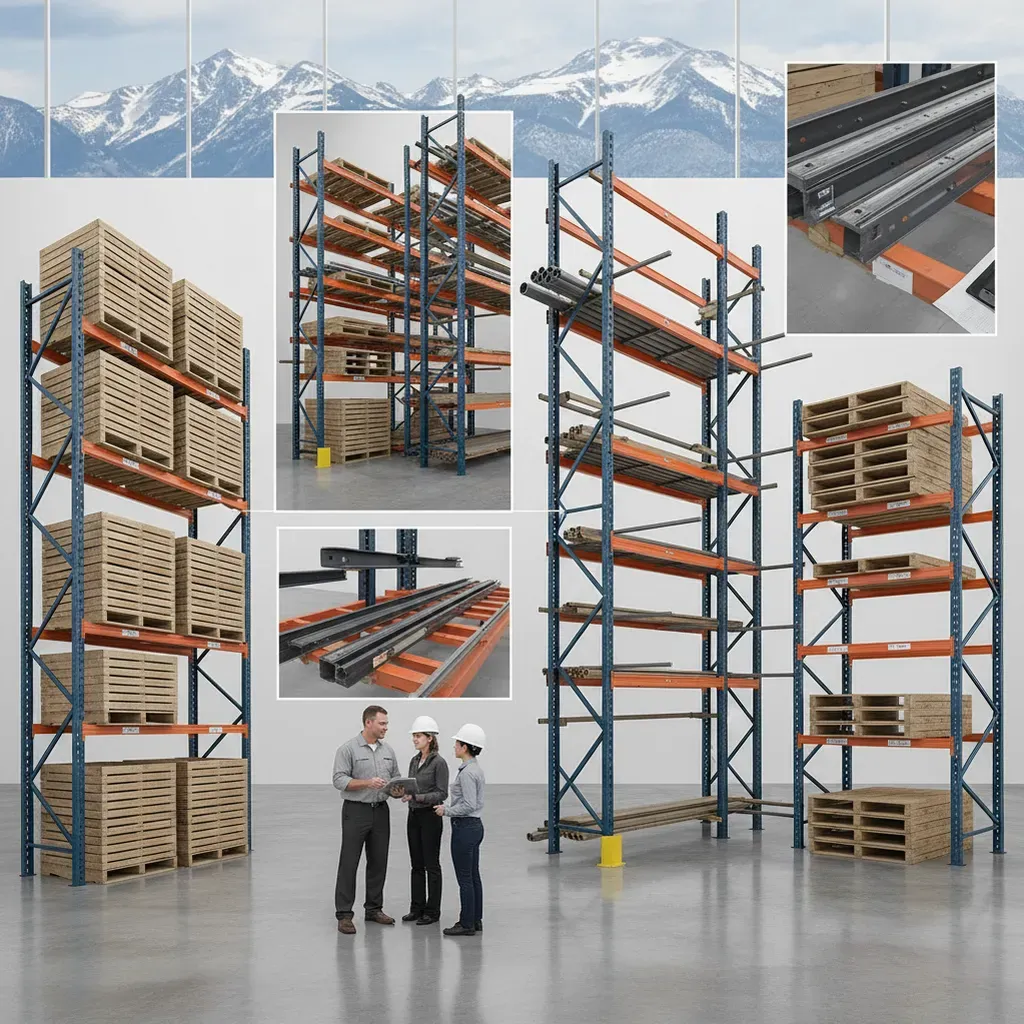
Comparisons for Pallet Racking in Denver
You’re sizing up comparisons on pallet racking versus shelving, push-back systems against drive-in racks, or even 3PL versus 4PL logistics because your Denver warehouse demands the best match for heavy loads and space efficiency. Local businesses come to us daily when they’re weighing costs, durability, and installation timelines to avoid costly mistakes.
Our crews, who’ve installed thousands of systems across the Metro area—from Aurora to Boulder—know these head-to-head matchups inside out. You’ve got the right questions. Below, we break down the comparisons our clients ask most, with straight talk from the team that builds them.
Top Comparisons Our Denver Clients Ask
What’s the difference between pallet racking and shelving?
Pallet racking handles full pallets up to 13,000 lbs per level following RMI standards, because it uses heavy-duty upright frames and beam levels designed for forklift access—which keeps your aisles clear and inventory stacked 4-6 levels high without collapse risk. Shelving caps at 1,000 lbs per shelf with clip-on supports, so it buckles under pallet weight, forcing you to break down loads manually and slowing throughput by 30-50%.
Push-back racking vs. drive-in racks—which wins for high-density storage?
Push-back racking pulls 4-6 pallets deep on wheeled carts per lane, because gravity-fed carts reduce forklift travel by 75%, letting one operator manage what takes four in selective racks. Drive-in racks shove pallets 8-10 deep on rails without carts, but they demand uniform loads to avoid jamming—which ties up bays during picks and hikes damage rates if SKUs vary.
What’s the best option for heavy items: pallet racking or bolted shelving?
Pallet racking always beats bolted shelving for loads over 2,000 lbs, because anchor-bolted uprights to 6,000 PSI concrete floors per IBC seismic codes in Colorado withstand dynamic forklift impacts, preventing tip-overs that shelving clips can’t match. Shelving warps under uneven heavy boxes, cutting usable height and triggering OSHA violations.
3PL vs. 4PL—which fits a Denver warehouse better?
3PL manages your storage and picking because they own the racks and labor, but lock you into their fixed layouts—which cramps growth as volumes spike. 4PL oversees multiple 3PLs for end-to-end logistics, integrating your ERP smoothly, so inventory accuracy hits 99.9% without you micromanaging carriers.
You recognize these comparisons directly impact your ops. You deserve a setup that scales with Denver’s demand surges. Of course, the right choice starts with your specs. That’s why we walk your floor free—call our team today.
Pricing Comparisons Our Clients Ask
How much does pallet racking cost installed in the Denver area?
Pallet racking runs $40-80 per pallet position installed—that means a typical 500-position system totals $20K-40K, including uprights, beams, and wire decking anchored to your concrete slab. Our crews factor in Colorado seismic codes and forklift traffic, so it handles 4,000-13,000 lbs per level without extras down the line. You recover that investment easily through 30-50% more floor space, ditching overflow rentals that bleed $5K+ yearly.
Push-back vs. drive-in racking—which costs less long-term?
Push-back racks start at $60-100 per position because rolling carts slash labor by 75%, equaling one operator’s output where drive-in needs three—drive-in hits $45-70 per position upfront but jams spike damage claims 20%. Over two years, push-back saves $15K+ on picks and repairs for high-turnover SKUs in Aurora warehouses.
What’s the value of racking repair versus full replacement?
Spot repairs cost $500-2,000 per bay—that translates to fixing bent beams or loose anchors in a day, restoring full capacity without downtime. Full replacement runs $5K-10K per bay, but our inspections catch 80% of issues early, because proactive welds per RMI standards prevent collapses and OSHA fines up to $15K.
Free estimate or ballpark—how does pricing work for my warehouse?
We deliver free on-site estimates within 24 hours because our team measures your Boulder or Lakewood space precisely, quoting exact $ ranges based on load specs and layout. No vague numbers—every bid includes teardown if needed. You deserve transparent pricing that fits. Call our crew now.
Safety & Compliance Comparisons Our Clients Ask
How does pallet racking stack up against shelving for OSHA compliance?
You realize a single damaged upright slashes your rack’s load capacity by 50% or more, because OSHA 1910.176 demands secure storage that prevents collapses—picture heavy pallets sagging on dented steel columns during a forklift bump, the metal groaning under strain as an inspector walks your Denver floor. Our crews anchor every system to exceed this standard with wire decking and beam locks, so you pass audits without shutdowns. Shelving fails here, clipping shelves that shear off under pallet weight.
Push-back vs. drive-in—which holds up better under seismic codes?
Notice how Colorado’s IBC seismic provisions (ASCE 7-16) require racks to resist 1.0g lateral forces in zones like Aurora, because uneven pallet loads in drive-in racks shift during quakes, risking domino tip-overs you feel in the floor shake. Push-back’s wheeled carts absorb motion better, distributing weight evenly across lanes. We engineer both to FM Global approval, bracing uprights that keep your inventory stable through Denver’s tremors.
Racking repair or replacement—which ensures long-term code compliance?
See bent beams as hidden time bombs under RMI/ANSI MH16.1 load specs, because unrepaired damage voids certifications and invites $15K OSHA fines per incident—imagine the screech of failing welds during peak shifts. Repairs restore full integrity with certified welds in hours; replacements only make sense for corroded frames. Our inspections flag 90% early, keeping you compliant.
What’s the compliance edge for local installers in Boulder vs. out-of-state crews?
Local teams like ours master Colorado’s building codes firsthand, because out-of-staters overlook slab anchors tuned to regional soils, triggering rejections. You picture your operation halted by failed walkthroughs.
You recognize these safety comparisons protect your team and bottom line. You deserve zero-risk compliance. Of course, our free audit confirms it all. Get your estimate today.
Make the Smart Choice After These Comparisons
You recognize these comparisons pinpoint the perfect fit for your warehouse loads and space. You deserve durable racks that crush downtime and costs. Of course, Denver-local crews deliver installations that outlast national quotes.
Our team covers the Metro—from Aurora to Boulder and Lakewood—with free on-site quotes in 24 hours, drawing on thousands of Colorado projects. Picture your optimized layout humming through surges, inventory accuracy at 99.9%, and zero compliance headaches ahead.
That’s your edge tomorrow. Reach our crew today.